Latin America: Land of Opportunity or Risky Business?

Date: 12/09/2024

Updated: 30/01/2026

Update: This article was updated to reflect 2025–2026 economic trends, risk developments, and evolving business opportunities in Latin America.

Latin America: Land of Opportunity or Risky Business?

BNR News Radio 📻 – International Business Risks in Practice

In this radio broadcast, TRANSFER’s CEO, Gerald Baal, discusses how companies can navigate political, financial, and operational risks with the goal of doing business successfully in countries of Latin America.💰

Also, Kees Huizinga, who has run a company with 300 employees for 20 years in Ukraine, shares his brave experiences about how to run a business during wartime. 📈

While recorded earlier, the strategic considerations discussed remain highly relevant for companies operating internationally today.

To frame these dynamics, the table below provides a comparative snapshot of key macroeconomic indicators across selected Latin American economies, including GDP growth trends and global rankings for 2025-2026. This overview offers a baseline for assessing relative opportunities and risks before exploring each country in more detail.

Argentina: Aggressive Reform Agenda Under Pressure

Since taking office, President Javier Milei has pursued an aggressive and disruptive approach focused on the reactivation of Argentina’s economy and restoring macroeconomic discipline.

📊Economic Indicators 

  • GDP growth is estimated at 4.5% in 2025, moderating to 4% in 2026.
  • 2025 year-end inflation reached 41.3%, the lowest since 2017. Further disinflation is expected, with an inflation rate of 16.4% projected for year-end, depending on fiscal discipline and the pace of liberalisation.
  • Reforms focus on deregulation, market liberalisation, and incentives for large-scale investment in strategic sectors.
  • Strong momentum from the energy sector (notably Vaca Muerta), mining, and renewed international confidence following extended IMF agreements.

🏛️ Political and institutional context

  • Poverty initially peaked in early 2024 following currency devaluation, before declining to 32% nationally by late 2025. Official projections suggest poverty could decline toward 14.5%-15.2% as real wages recover.
  • Income inequality has begun to ease after a sharp widening in 2024. The Gini index improved from 0.46 to 0.43 by Q1 2025
  • Public support for reforms remains significant despite short-term economic hardship.
  • Political support exists, but structural friction persists. Large-scale protests against labor and pension reforms led to high-profile general strikes.

Venezuela: Navigating Political and Economic Turbulence

Despite occasional signs of economic activity growth, Venezuela’s political and economic environment remains highly unstable. Businesses and investors should approach with caution and develop robust strategies to navigate this volatile market.

📊 Economic Indicators:

  • Despite a reported 8.7% growth in late 2025 by the Central Bank, the IMF projects a sharp 3.0% reduction in 2026 driven by new sanctions and falling oil production.
  • Inflation has declined from hyperinflationary peaks of over 2,900% in 2020, but it remains the world’s highest, ending 2025 at 269.9% with projections soaring to over 600% in 2026.
  • Public debt levels remain elevated, estimated at over 160% of GDP, constraining fiscal flexibility and sovereign financing options. 
  • The undiversified economy relies heavily on oil, which accounts for about 25% of GDP.
  • Unemployment is expected to hit 35% by 2026, worsening a poverty crisis where over 80% of the population is estimated to live in poverty.

The 2026 predictions are highly unstable, reflecting the country’s volatile political and economic situation. While these projections offer a potential direction for the situation, they should be viewed with caution and no certainty!!

🏛️ Political and institutional context

  • Nicolás Maduro was arrested by U.S. forces on January 3, 2026, on international legal charges and sanctions, leading to a major political shift in Venezuela.
  • The Venezuelan Supreme Court declared a “temporary impossibility” for Maduro to serve, appointing Vice President Delcy Rodríguez as the Acting President.
  • The interim government faces intense pressure from Washington to distance itself from allies (Russia, China, Cuba) and align with Western interests.
  • On January 29, 2026, Acting President Rodríguez signed a landmark law officially opening Venezuela’s nationalized oil sector to privatization.
  • This move is expected to create significant opportunities for U.S. and some for European companies, especially those specializing in offshore solutions, dredging, and infrastructure revamping.

Brazil: A Beacon of Economic Stability in South America 

As the largest economy in Latin America and the world’s 11th economy, Brazil offers a comparatively stable and secure environment for international business and investment within South America. This makes Brazil a key reference market for companies seeking stability in the region.

📊 Economic Indicators

  • Brazil’s GDP growth is projected to slow to 1.9% in 2026, down from the projected 2.4% in 2025.
  • The country maintains a strong domestic market and regional influence due to its large, diversified economy.
  • Key sectors include agribusiness (soybeans, beef, corn) and industrial mining. 
  • Inflation is expected to slightly decrease to 4.0% in 2026 (from 5.2% in late 2025). 
  • China remains the top trading partner, accounting for about 30% of 2025 exports.

🏛️ Political and institutional context

  • Under President Luiz Lula da Silva, Brazil continues to navigate political debate and institutional complexity, but democratic institutions remain intact and policy continuity broadly predictable.
  • Structural issues persist, including income inequality and infrastructure gaps.
  • Understanding political and social dynamics is essential for businesses aiming to thrive in this market.
  • Regulatory complexity and bureaucracy remain key challenges for foreign investors.

Colombia: Strong Fundamentals, Growing Constraints

Economic growth in Colombia has slowed amid persistent inflationary pressures, yet the country remains the fourth-largest economy in Latin America, supported by a diversified resource base and strong industrial sectors.

 📊Economic Indicators

  • GDP growth rose to 1.6% in 2024 and is expected to reach around 2.3% in 2026.
  • Inflation hit a 13-month high of 4.9% in October 2025, considerably surpassing the central bank’s target of approximately 3%.
  • The unemployment rate is 9.41%, with nearly 60% of the workforce employed in informal jobs.

🏛️Political and institutional context

  • Gustavo Petro’s leftist campaign started in 2022.
  • Ambitious reform agenda focusing on social spending, pensions, labour, and healthcare.
  • Implementation of the reform has been slowed by limited congressional support and fiscal pressures.
  • Public debt is a major topic in Colombia’s political future.
  • The country faces high public debt, elevated poverty, and inequality.

Mexico: Landscape of mixed opportunities

Mexico, the world’s 13th largest economy by nominal GDP and a major manufacturing center, remains Latin America’s second-largest economy. However, its future is less certain. Slowed growth, fiscal challenges, and changes in institutional policies are prompting increased caution among investors.

 📊Economic Indicators 

  • After solid growth in 2024, economic momentum slowed sharply in 2025, with 2026 growth projected at 1.5%. 
  • After a period of volatility peaking in 2022, inflation has trended downward and stabilized within the central bank’s target range, currently sitting at 3.3% in Q4 2025.
  • Mexico’s trade is highly reliant on the US, which accounted for 61% of its 2025 exports.
  • China is a primary source of imports for Mexico (10.4%), mainly providing electronics and machinery.
  • To reduce the large trade deficit with Asia, Mexico is using an import substitution plan, raising tariffs to replace Asian components with domestic or North American goods.
  • Strong manufacturing base, particularly in automotive and electronics.

🏛️Political and institutional context

  • President Claudia Sheinbaum has consolidated executive power, supported by strong electoral backing.
  • Recent constitutional and judicial reforms have increased concerns around legal certainty, contract enforcement, and regulatory stability.

Chile: Macroeconomic Stability Amid Structural Pressures

Chile continues to stand out as one of Latin America’s more stable and institutionally credible economies, although moderating growth, fiscal constraints, and persistent inequality are shaping a more cautious outlook for investors.

  📊Economic Indicators 

  • GDP growth accelerated to 2.6% in 2024. Growth is expected to moderate to 2.5% in 2025, with projections around 2% in 2026, reflecting resilient economic growth.
  • Inflation stabilised at 3.4% in Q4 2025, the lowest level since 2021. Headline inflation is expected to continue declining, approaching the 3% target by end-2026.
  • Public debt has greatly increased leading to renewed importance on spending restraint and fiscal consolidation policies.
  • Chile continues to display a high Gini coefficient (0.41), highlighting the need for policies that address income disparities and promote more inclusive growth.
  • The economy remains anchored in agriculture and mining, with strong export performance, alongside manufactured products.
  • Public and private investment is increasingly directed toward green energy and digital transformation.

🏛️Political and institutional context

  • A recent political shift to the right has brought new leadership with President José Antonio Kast, prioritising public security, crime reduction, and lower public spending.
  • Chile remains a stable democratic republic with comparatively low corruption levels relative to neighbouring countries, supporting institutional credibility.
  • Security concerns remain a prominent political issue.

🎤 Listen to the radio interview here:

https://omny.fm/shows/wereldspelers-bnr/kees-huizinga-is-ondernemer-in-oekra-ne-medewerker/embed


Key takeaways 

For companies considering expansion, sourcing, or investment in Latin America, success increasingly depends on careful market selection, strong local knowledge, and robust risk-mitigation frameworks.

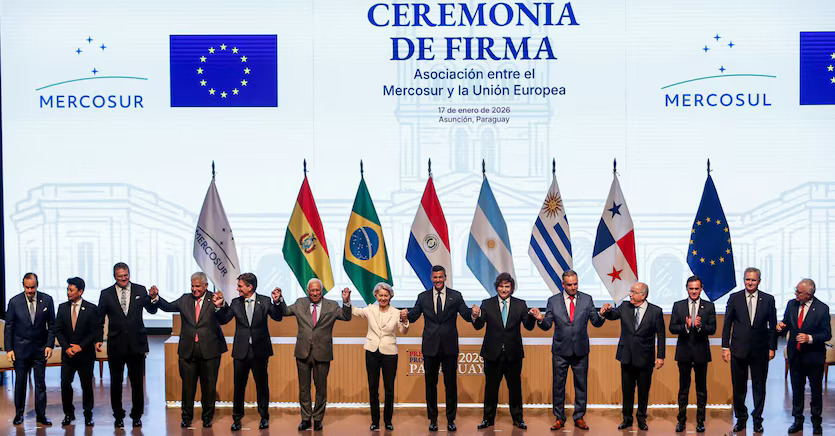
Regional integration dynamics, particularly through frameworks such as the EU–Mercosur Agreement, will play an increasingly important role in shaping trade and investment strategies across South America. We explore these implications in more detail in our dedicated article,  EU-Mercosur: What European Businesses need to know.

TRANSFER.LC supports companies in assessing country risk, structuring market entry, and developing resilient international strategies. Contact us to discuss how we can help you navigate opportunities and risks across Latin America.


Methodology note:
All GDP levels and global rankings are based on IMF World Economic Outlook (WEO) data, using nominal GDP (USD) for 2024 (actual) and IMF estimates for 2025 and 2026. GDP growth rates refer to real GDP growth. Inflation figures are based on the IMF Consumer Price Index (CPI), annual percentage change, using the October 2025 IMF update (latest available at the time of writing).

Get in Touch!

If you are interested in this country, or you would like to expand to one of the other main markets in the Americas or Europe, contact us via the form, and we will get back to you shortly.

    Related

    Trending Blog

    EU-Mercosur: What European Businesses Need to Know

    The EU-Mercosur agreement marks a significant shift in trade relations between Europe and South America. While full implementation will take time, the deal has clear implications for European companies in terms of market access, costs, regulatory conditions and supply-chain strategy. This article outlines what is changing, when it may start to matter, and which businesses stand to benefit most.

    29/01/2026

    Powering the Future: Offshore Wind Innovation in the Benelux

    Rising energy costs, geopolitical uncertainty, EU climate targets, and global supply chain competition make offshore wind innovation in the Benelux more critical than ever. The Netherlands and the wider region are emerging as a global reference for offshore wind, combining ambitious long-term capacity plans with a mature supply chain and a strong export record across Europe, Asia, and the Americas. This article explains how Benelux is combining policy, technology, and international partnerships to build the next generation of offshore wind.

    10/12/2025

    France: Market Opportunities for Foreign Companies in Water, Energy, and Environment

    France’s sustainability sectors are experiencing rapid growth, creating significant opportunities for foreign companies in water treatment, renewable energy, and circular-economy solutions. With ambitious national targets for decarbonization, water management, and resource efficiency, France is positioning itself as a European hub for environmental innovation and market expansion. This article explores the key market opportunities, sector trends, and areas where international companies can contribute to France’s green transition.

    17/10/2025