


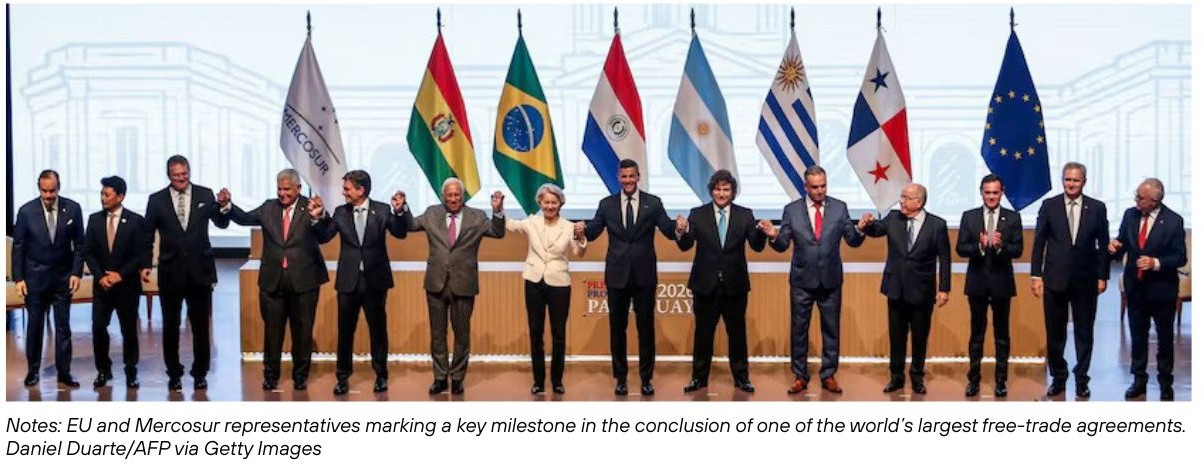
After more than 25 years of negotiations, the EU and Mercosur have reached a decisive milestone with the signing of one of the largest free-trade agreements worldwide. Once implemented, the deal will create a free-trade area of more than 700 million consumers, accounting for almost 20% of global GDP.
While the macroeconomic impact on the EU is expected to remain moderate, the agreement carries significant implications for European companies. Beyond trade volumes, it plays an important strategic role by supporting supply-chain diversification at a time of heightened geopolitical tension. Mercosur offers access to critical raw materials and green technologies, helping reduce dependencies on both China and the United States.

For companies, this translates into stronger resilience, improved market access, greater regulatory predictability, and enhanced long-term positioning in Latin America, both in- and outbound. In practical terms, Mercosur brings together four South American economies—Argentina, Brazil, Paraguay, and Uruguay—whose combined market size and geographic reach highlight the bloc’s strategic relevance for Europe. In addition, this would also make neighbouring markets in the region, more accessible for European companies.
What changes for European businesses
At its core, the agreement reduces barriers that have long made EU–Mercosur trade complex. For European companies, this translates into four concrete changes: lower trade costs, wider market access, greater regulatory predictability, and stronger supply chain resilience.

What drives the changes
These impacts are driven by a limited set of practical measures, including:
- A gradual reduction of tariffs on key goods;
- Improved access to public procurement markets with built-in safeguard;
- Closer regulatory cooperation.
Rather than changing standards, the agreement focuses on lowering costs and increasing predictability for European companies operating in Mercosur markets.
Who benefits the most
The agreement is particularly relevant for European export-oriented industrial firms such as machinery, chemicals, and transport equipment, as well as companies active in infrastructure, energy, and digital services. It also benefits SMEs with strong brands or protected geographical indications and businesses seeking to diversify supply chains and reduce dependency on single markets.
For European companies that import goods from South America, the agreement is unlikely to trigger immediate day-to-day changes, as tariff reductions will be phased in gradually. However, it is expected to improve supply chain stability over time by facilitating more predictable access to critical raw materials and agricultural products, benefiting importers with medium- to long-term sourcing strategies.
When does it start to matter
The agreement is structured in two implementation phases:
- The Interim Trade Agreement (iTA) covers trade and investment; it is designed to enter into force quickly as it requires only the European Parliament’s consent;
- The broader EU–Mercosur Partnership Agreement (EMPA) requires ratification by all 27 EU member states, which introduces uncertainty regarding the timeline. Current estimates suggest that full signature could take up to two years.

Despite recent political backing by the European Commission, parliamentary and legal hurdles remain. Diplomatic sources expect provisional application of the agreement in the near term, and while the agreement is not yet fully operational, companies that start preparing early will be better positioned once implementation begins.
Why Mercosur matters as a market
Even before the agreement, economic ties between the EU and Mercosur were substantial and relatively stable. In 2024, trade in goods reached approximately €111 billion, with the EU accounting for nearly 17% of Mercosur’s total trade.

Trade and investment flows within Mercosur are highly concentrated. Brazil alone represents more than 80% of EU–Mercosur trade, making it the primary entry point for many European companies into the wider regional market. This concentration makes Mercosur easier to approach strategically but also increases exposure to country-specific risks.
A specific focus on SMEs
For small and medium-sized enterprises (SMEs), the agreement lowers several traditional barriers to internationalization, particularly in regulatory procedures and market access, while raising new competitive and operational challenges.

Key risks to monitor
Beyond implementation timelines, companies should factor in a set of risks:
- Political and ratification uncertainty: Final approval remains subject to parliamentary processes at the EU, creating uncertainty around the full implementation.
- Agricultural competition concerns: European beef and poultry producers fear increased competition from imports, partly due to differences in production and cost structures.
- Environmental and climate scrutiny: Public debate continues around the agreement’s environmental impact, particularly regarding deforestation and increased trade.
To tackle these issues, the agreement includes safeguard mechanisms and quotas, particularly for sensitive agricultural sectors, helping to limit exposure to sudden market disruptions.
These considerations reflect broader challenges of operating in Latin America, which we explore in more detail in our analysis LATAM: Land of Opportunity or Risky Business?
Strategic importance for green investment
Beyond trade, the agreement carries strategic relevance for Europe’s green and industrial agenda. Mercosur offers opportunities to diversify access to critical raw materials while also supporting potential green partnerships. For European companies, this reduces dependency on China for key inputs and aligns with both EU Green Deal objectives and corporate ESG strategies.
This creates opportunities to invest in energy and industrial projects aligned with the EU’s green and digital transition.
Takeaways
- While the agreement is not immediate, recent developments suggest that provisional application could begin in the near term,
- Early movers are likely to benefit most once implementation progresses,
- Impacts vary by sector and company size,
- Strategic, regulatory, and supply-chain considerations are central.
What businesses should do next
European companies should begin assessing their exposure to Mercosur markets, identifying potential partners, and monitoring the ratification timeline. Early preparation, particularly in areas such as regulatory compliance, sourcing strategies, and market entry planning, can provide a clear advantage once the agreement enters into force.
For additional context on operating in Latin America, see our article “Back to where it all began: Latin America!” alongside a radio interview featuring our CEO, Gerald Baal, discussing practical considerations for companies entering the region.
Related
Trending Blog
Why do we always look to London for business opportunities in the UK, when the actual industry lies elsewhere?

Powering the Future: Offshore Wind Innovation in the Benelux
Rising energy costs, geopolitical uncertainty, EU climate targets, and global supply chain competition make offshore wind innovation in the Benelux more critical than ever. The Netherlands and the wider region are emerging as a global reference for offshore wind, combining ambitious long-term capacity plans with a mature supply chain and a strong export record across Europe, Asia, and the Americas. This article explains how Benelux is combining policy, technology, and international partnerships to build the next generation of offshore wind.
10/12/2025

France: Market Opportunities for Foreign Companies in Water, Energy, and Environment
France’s sustainability sectors are experiencing rapid growth, creating significant opportunities for foreign companies in water treatment, renewable energy, and circular-economy solutions. With ambitious national targets for decarbonization, water management, and resource efficiency, France is positioning itself as a European hub for environmental innovation and market expansion. This article explores the key market opportunities, sector trends, and areas where international companies can contribute to France’s green transition.
17/10/2025
